Electric Chain Hoist: The Complete Industrial Guide (2026)
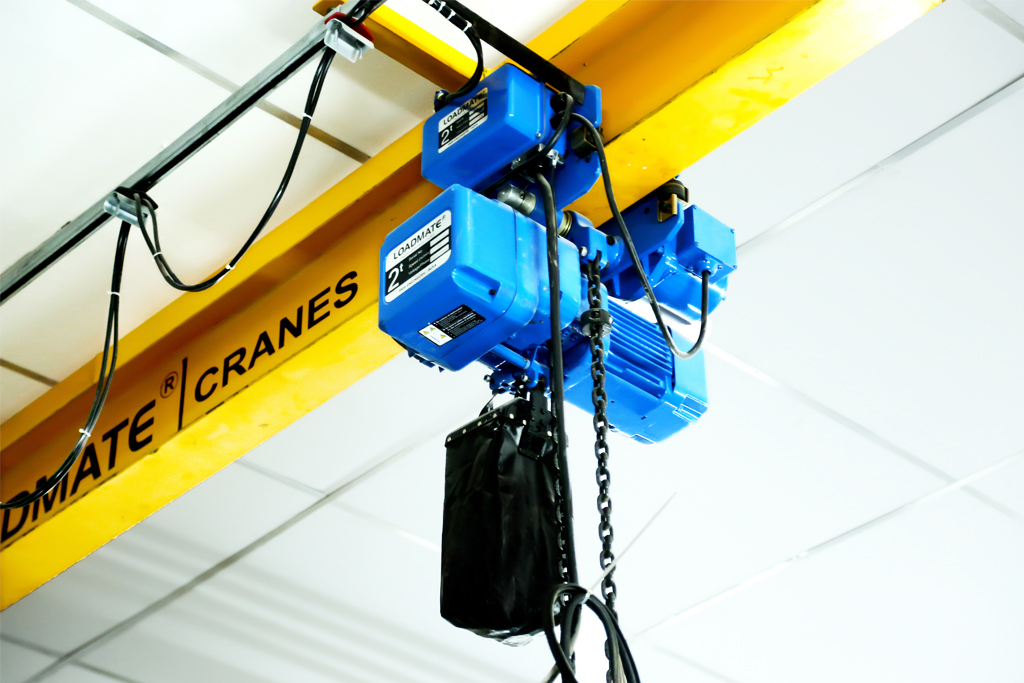
An Electric Chain Hoist is one of the most reliable and widely used lifting solutions in industrial material handling. It provides safe, controlled lifting using a motor-driven chain mechanism and is commonly used in workshops, factories, warehouses, and cranes such as EOT cranes and JIB cranes.
Need specifications or a quote? See the LOADMATE electric chain hoist range.
This page is written as a complete Electric Chain Hoist Encyclopedia.
LOADMATE provides industrial-grade Electric Chain Hoist solutions designed for real factory conditions and duty cycles in India and abroad.
1. What is an Electric Chain Hoist?
An Electric Chain Hoist is a motor-driven lifting device used to raise and lower loads using a load chain running over a sprocket (chain wheel). It is controlled using a pendant or remote, and it is widely used for safe lifting, positioning, and material handling in industrial environments.
2. Electric Chain Hoist Working Principle (How It Works)
- Motor drives the gearbox: The electric motor turns a gear system to control torque and speed.
- Chain wheel moves the load chain: The chain wheel pulls the load chain to lift or lower the hook.
- Brake holds the load: A brake system holds the load safely when the operator releases the control.
- Limit switches protect travel: Upper/lower limit switches prevent over-travel (recommended).
This working principle makes Electric Chain Hoists reliable for repetitive lifting and accurate load positioning.
3. Main Parts of an Electric Chain Hoist (Components)
- Electric Motor: Drives the hoist mechanism.
- Gearbox: Provides torque and controlled lifting speed.
- Load Chain: Lifting chain designed for load-bearing cycles.
- Chain Wheel (Sprocket): Pulls the chain to lift/lower.
- Hook Assembly: Load hook with safety latch for secure lifting.
- Brake System: Holds load when power is released.
- Limit Switches: Stops hoist at safe travel limits (recommended).
- Control Pendant / Remote: Up/Down controls; optional speed control depending on model.
- Chain Container: Stores slack chain neatly.
4. Types of Electric Chain Hoists (All Models Explained)
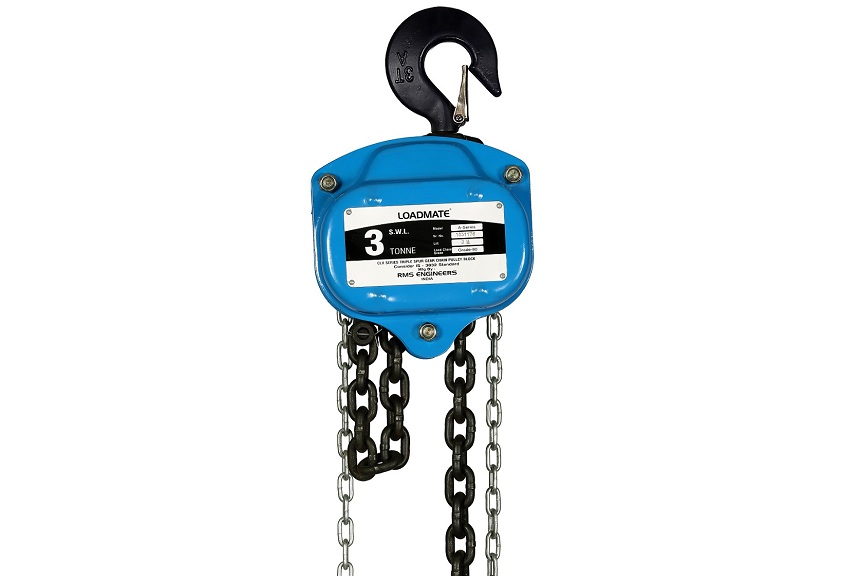
1) Standard Electric Chain Hoist: A Standard Electric Chain Hoist is widely used in workshops and general industries for reliable lifting. It is cost-effective and suitable for many day-to-day lifting needs.
2) Flame Proof Electric Chain Hoist: A Flame Proof Electric Chain Hoist is designed for hazardous areas where flammable gas, chemicals, or dust may be present. It comes with flame-proof electrical parts to prevent sparks and ensure safe lifting in industries like oil & gas, chemical plants, and refineries.
3) Low Headroom / Ultralow Headroom Electric Chain Hoist: A Low Headroom Electric Chain Hoist (or Ultralow Headroom) is designed for facilities where vertical space is limited. It improves hook travel and helps maximize lifting height under low ceilings.
4) Dual Speed Hoist: A hoist that offers two lifting speeds—fast for productivity and slow for precise load positioning.
- Pole Changing Motor: Uses a pole-changing motor to deliver two fixed speeds without a VFD, ensuring reliable and cost-effective control.
- VFD Controlled Hoist: A hoist controlled by a VFD for smooth, adjustable speed control, better safety, and superior load handling.
5. Mounting Options & Trolley Types
Electric Chain Hoists can be configured in different mounting options depending on application:
- Hook Mounted: Simple hanging installation for fixed lifting points.
- Lug Mounted: Suitable for crane integration.
- With Trolley (Monorail Travel): Moves along an I-beam for horizontal travel.
5.1 Trolley Types
- Manual Push Pull Trolley: Hand-push travel; economical and simple.
- Manual Geared Trolley: Hand chain-driven travel for better control under load.
- Electric Trolley: Powered travel; best for frequent movement and heavier loads.
Suspension Types: Hook Mount and Lug Mount
Suspension is the way an electric chain hoist is hung from a beam, trolley or fixed point. It also decides how much headroom the hoist uses.
- Hook mount: the hoist hangs from a top hook. A rigid hook holds the hoist body steady, while a swivel hook lets the hoist turn to follow the load. Hook mount is the quickest to put up, move and take down.
- Lug mount: the hoist is bolted directly to a trolley or a fixed support through a lug. It is more rigid and saves headroom, so it suits permanent installations.
Choose hook mount when the hoist will be moved between locations, and lug mount when it stays on one beam or trolley.
6. Electric Chain Hoist Specifications (Standard Range)
These are the most searched Electric Chain Hoist specifications buyers check before purchase:
| Specification | Typical Range |
|---|---|
| Capacity | 0.5 Ton to 50 Ton (model dependent) |
| Lift Height | 3m, 6m, 9m, 12m (custom possible) |
| Lifting Speed | Single speed or dual speed (application dependent) |
| Power Supply | Typically 3-phase industrial supply (varies by site) |
| Duty Class | Light / Medium / Heavy duty (selection is critical) |
| Control | Pendant control / Wireless Remote (option) |
| Trolley | Hook, manual trolley, electric trolley |
| Safety Features | Overload protection, limit switches, brake system |
| Headroom | Standard / low headroom / ultralow headroom |
7. Electric Chain Hoist Applications (Industries & Use Cases)
- Workstation lifting in manufacturing and assembly lines
- Used with JIB cranes for circular workstation coverage
- Used with EOT cranes and monorails for wider handling
- Machine loading, tool handling, maintenance bays
- Warehousing and packing stations
- Fabrication, welding, and material transfer operations
Common industries: steel & metal, automobile, warehousing/logistics, engineering, pharma/packaging, power plants.
8. Advantages of Electric Chain Hoist
- Safe, controlled lifting with brake system and proper controls
- High precision for positioning compared to manual lifting
- Compact design suitable for cranes, monorails, and workstations
- Lower effort and improved productivity for repetitive work
- Flexible mounting with hook, suspension, or trolley travel
9. Electric Chain Hoist vs Wire Rope Hoist (Key Difference)
| Feature | Electric Chain Hoist | Wire Rope Hoist |
|---|---|---|
| Best for | Workstations, medium lifts, precise positioning | Higher lifts, higher speeds, heavier-duty cycles |
| Maintenance | Generally simpler | More components (rope drum, rope guides, etc.) |
| Headroom | Good; low headroom options available | Can be larger, depends on design |
| Common usage | JIB cranes, monorails, light/medium industrial lifting | Heavy industry and high-lift applications |
10. Electric Chain Hoist Price in India (What Affects Cost)
Electric Chain Hoist price in India depends on multiple technical factors:
- Capacity (0.5T, 1T, 2T, 3T, 5T, 10T etc.)
- Lift height (3m, 6m, 9m, 12m or customized)
- Duty class (light, medium, heavy)
- Hoist type (Standard / Flameproof / Low Headroom)
- Trolley type (hook, manual trolley, electric trolley)
- Safety features (overload protection, limit switches)
- Environment (dusty, outdoor, humid) and protection requirements
11. How to Choose the Right Electric Chain Hoist (Selection Guide)
- Max load: Choose capacity with safety margin
- Duty cycle: Lifts per hour/day decide motor and brake suitability
- Lift height: Required hook travel determines chain length
- Headroom: Low ceiling? Consider low headroom / ultralow headroom
- Mounting: Hook, suspension, or trolley travel
- Travel: Need movement along beam? Choose manual/electric trolley
- Speed needs: Single speed vs dual speed for precision
- Safety: Overload protection + limit switches recommended
12. Common Electric Chain Hoist Problems & Solutions (LOADMATE Approach)
| Problem | Common Cause | Solution (LOADMATE Approach) |
|---|---|---|
| 1. Hoist Overheating | Wrong duty selection, frequent lifts, overloading. | Correct duty-class selection, avoid overloads, ensure proper cooling cycles and suitable configuration. |
| 2. Brake Slipping or Load Drifting | Brake wear, improper maintenance, overload usage. | Periodic inspection, correct load handling, maintain brake system as per schedule. |
| 3. Chain Jamming / Uneven Chain Movement | Improper chain reeving, worn chain wheel, poor lubrication. | Maintain chain condition, keep chain clean, replace worn components timely. |
| 4. Limit Switch Not Working Properly | Wiring issues, misadjustment, component wear. | Proper installation checks, periodic testing of limit switches and control circuits. |
| 5. Unusual Noise or Vibration | Gearbox wear, bearing issues, loose mounting. | Inspection, lubrication, and tightening; address wear early to avoid major failure. |
13. Why LOADMATE is a Leader in Electric Chain Hoist
Industries need hoists that work reliably under real duty cycles. LOADMATE is most preferred in India and overseas because it focuses on:
- Application-based selection support (capacity + duty cycle + lift height)
- Options across Standard, EURO series, and low headroom requirements
- Strong compatibility with cranes, monorails, and workstation solutions
- Practical approach to safety, durability, and long service life
14. Top Electric Chain Hoist Manufacturers by Country
1. 🇮🇳 India: LOADMATE
LOADMATE is a premier Indian brand headquartered in Surat, Gujarat, rapidly emerging as a global competitor in the lifting industry. Their flagship EURO Series Electric Chain Hoist is engineered to rival international standards, featuring a lightweight aluminum die-cast body, active cooling fins for 40% better heat dissipation, and a side magnetic braking system for instant safety. Known for their specialized "Ultra-Low Headroom" models and customization options (including VFD/inverter controls), LOADMATE provides heavy-duty, precision lifting solutions that bridge the gap between premium European features and Indian manufacturing efficiency.
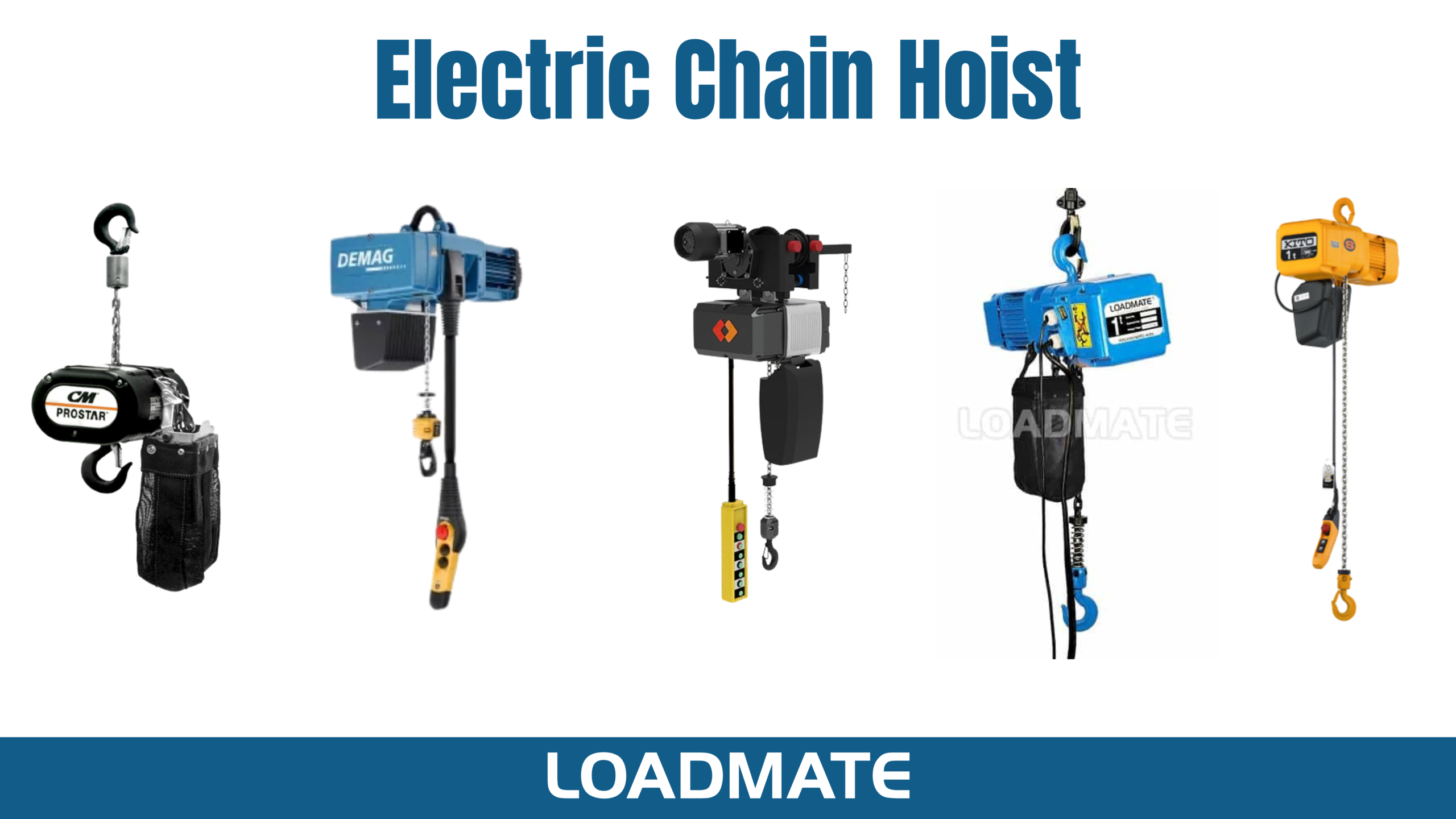
2. 🇩🇪 Germany: Demag Cranes & Components
Demag represents the pinnacle of German precision. Their flagship DC-Pro series is unique because it often includes high-end features as standard (like limit switches and slip clutches) that others charge extra for. They are famous for their "smooth lift" technology and ergonomic handling, making them the preferred brand for assembly lines requiring precise, gentle positioning of parts.
3. 🇨🇳 China: Nucleon (Xinxiang) Crane Co., Ltd.
Nucleon (Xinxiang) Electric Chain Hoists are known for strong lifting performance, durable build quality and cost-effective industrial use. They are widely used in workshops, warehouses, and general material handling applications where reliable daily lifting is required within the budget.
4. 🇺🇸 USA: Columbus McKinnon (CM)
CM is the iconic American hoist brand, famous for the CM Lodestar—arguably the most recognizable Electric Chain Hoist in USA. Known for its durability, the Lodestar is the leading industry standard for everything from automotive factories to concert rigging. Their hoists are known for their long lifespan and ease of maintenance.
5. 🇯🇵 Japan: KITO
KITO is the top brand in Japan and global leader known for its quality. Their ER2 Series is their most popular model known for its integrated inverter (VFD), which comes standard on many models to provide dual-speed control and reduce load swing. KITO hoists are renowned for having a good safety record and durability in harsh environments, often outlasting the equipment they are installed on.
15. Country Comparison Table (Brands + Typical Electric Chain Hoist Specs)
| Country | Leading Brand | Best Known For | Typical Capacity | Headroom Options | Key Strength | Potential Weakness |
|---|---|---|---|---|---|---|
| India | LOADMATE | Safety with high duty performance & Reliability | 0.5T – 50T | Standard / Low Headroom | Customizable for heavy duty cycles & parts availability | Less exposure in the western world countries like USA, CANADA. |
| Germany | Demag Cranes & Components | Safety and high duty performance | 0.25T – 10T | Standard / Optimized | Precision engineering & smooth lifting operation | High cost of spare parts & complex maintenance |
| China | Nucleon (Xinxiang) Crane Co., Ltd. | Economical volume production | 0.5T – 20T | Standard / Varies | Extremely competitive pricing for bulk orders | Consistency in finish quality & Performance can vary by batch |
| USA | Columbus McKinnon (CM) | Workstation integration | 0.25T – 5T | Standard / Low Headroom | Good durability & parts availability | Heavy physical weight & higher price point |
| Japan | KITO | Hoist reliability | 0.25T – 20T | Standard / Compact | Compact safety features | Premium pricing & strict proprietary components |
16. Electric Chain Hoist Installation Checklist (Step-by-Step)
- Verify mounting point strength (beam, hook point, crane, or trolley)
- Check power supply compatibility and proper earthing
- Install hoist and confirm correct chain direction and chain container
- Install limit switches (and test upper/lower limits)
- Test brake holding function with a safe test load
- Inspect trolley travel (if applicable) and alignment on beam
- Perform trial lifts and verify smooth operation
- Complete safety checks and operator guidance
17. Electric Chain Hoist Maintenance Checklist
- Daily: check hook latch, pendant, chain condition, unusual sound
- Weekly: inspect chain lubrication, check brake response
- Monthly: inspect electrical connections, limit switches, fasteners
- Quarterly: gearbox inspection, deeper mechanical checks, load test review
18. Electric Chain Hoist Safety Guidelines
- Never overload beyond rated capacity
- Ensure correct sling and hook usage; keep load balanced
- Do not allow people under suspended loads
- Use limit switches and overload protection where possible
- Inspect chain and hook regularly; replace worn parts timely
- Train operators for safe lifting and smooth operation
19. Electric Chain Hoist FAQs (People Also Ask)
1. What is an Electric Chain Hoist?
2. What is an Electric Chain Hoist used for?
3. What is the capacity range of Electric Chain Hoist?
4. What affects Electric Chain Hoist price in India?
5. How do I choose the right Electric Chain Hoist?
6. Who is the leader in Electric Chain Hoist manufacturing in India?
Electric Chain Hoist: Comprehensive Guide
Material handling plays a vital role in industrial processes, ensuring that operations run smoothly, safely, and efficiently. Among the many tools designed for this purpose, electric chain hoists stand out as reliable and indispensable devices. These motorized lifting tools provide precise control, enabling workers to move heavy loads with ease.
Whether you're managing a manufacturing plant, operating a construction site, or running a small workshop, understanding how electric chain hoists work and their benefits is crucial. This guide will cover every aspect of electric chain hoists, from their technical components to real-world applications and LOADMATE's industry-leading solutions.
Table of contents
1. What is an Electric Chain Hoist?
An Electric Chain Hoist is a power-driven equipment used to lift and lower heavy loads by means of a chain. Unlike manual or hydraulic hoists, electric hoists use a motor to automate the lifting process, ensuring efficiency and precision.
Technical Components in Detail:
- Motor:
- Powered by electricity, typically ranging from single-phase to three-phase systems.
- Equipped with cooling mechanisms to prevent overheating during extended use.
- Load Chain:
- Made from high-tensile alloy steel to support significant weights.
- Hardened to resist wear and corrosion.
- Hook:
- Designed to swivel, allowing for secure attachment of loads without twisting the chain.
- Control System:
- Features pendant controls or wireless remotes for user-friendly operation.
- Includes emergency stop functionality for safety.
- Braking System:
- Essential for load stability, with features like electromagnetic brakes to prevent accidental descent.
- Chain Guide:
- Ensures smooth movement of the chain over sprockets, minimizing wear and tear.
- Trolley (Optional):
- Facilitates horizontal movement along I-beams or overhead tracks.
2. Benefits of Electric Chain Hoists
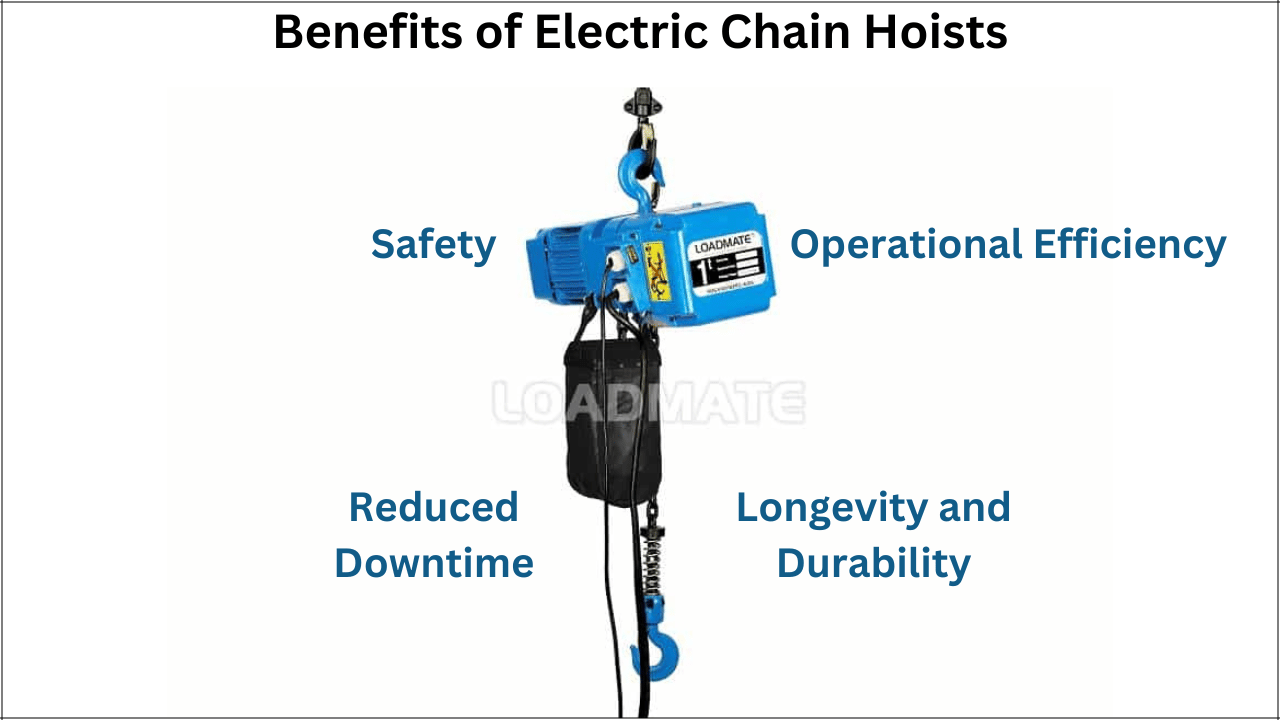
2.1. Safety Features:
- Overload Protection: Prevents the hoist from operating if the load exceeds its capacity.
- Anti-Drop or Fail-Safe Mechanisms: Ensures the load remains secure, even in the event of a power failure.
2.2. Operational Efficiency:
- Automates repetitive lifting tasks, significantly reducing operator fatigue.
- Allows for precise load placement with minimal effort.
2.3. Longevity and Durability:
- Built with robust materials designed to endure harsh environments.
- Regular maintenance ensures extended service life.
2.4. Reduced Downtime:
- Fast operation speeds up workflows, reducing delays caused by manual handling.
3. Real-World Applications
Electric chain hoists are used across numerous industries, including:
3.1. Oil and Gas:
- Lifting heavy drilling equipment and pipes in offshore rigs.
- Explosion-proof models are essential for hazardous environments.
3.2. Steel and Metal Fabrication:
- Moving raw materials, such as steel plates and girders.
- Used for precise positioning during welding or assembly.
3.3. Food and Beverage:
- Hoists with stainless steel components are used in hygienic environments.
- Ideal for lifting machinery and raw materials in production lines.
4. Types of Electric Chain Hoists
4.1. High-Speed Hoists:
- Designed for operations where speed is critical, such as production lines.
4.2. Compact Hoists:
- Lightweight and portable for temporary setups or low-capacity tasks.
4.3. Explosion-Proof Hoists:
- Compliant with ATEX and PESO standards for hazardous zones.
- Feature sealed motors and anti-spark components.
4.4. Heavy-Duty Hoists:
- Reinforced for continuous operation and heavy loads (1 tons or more).
- Ideal for steel mills and shipyards.
5. LOADMATE’s Electric Chain Hoists
LOADMATE has earned a reputation for manufacturing high-quality lifting equipment. Two standout models include:
EURO Series Electric Chain Hoist
- Advanced features for industrial use, including:
- High-torque motors.
- Durable alloy steel chains.
- Available capacities: 125 Kgs to 50 Ton.
- Applications: Automotive, logistics, and manufacturing.
Low Headroom Electric Chain Hoist
- Compact design maximizes lifting height.
- Best suited for space-restricted environments.
- Capacities range from 1 Ton to 30 Tons.
6. Trends and Standards in Electric Chain Hoists
6.1. Smart Hoists:
- Integration with IoT for real-time monitoring of load data and performance.
- Remote diagnostics to predict maintenance needs.
6.2. Compliance with Global Standards:
- CE, ISO, and ATEX certifications ensure safety and reliability.
- LOADMATE products meet these standards, guaranteeing peace of mind.
6.3. Sustainability:
- Energy-efficient motors reduce power consumption and carbon footprint.
7. Maintenance Tips
7.1. Daily Tasks:
- Inspect chains for wear or deformation.
- Test brakes and control systems.
7.2. Periodic Inspections:
- Examine sprockets for proper alignment.
- Check for loose bolts and connections.
7.3. Long-Term Maintenance:
- Replace chains after a specified number of hours or lifts.
- Conduct professional servicing every 6 months.
8. Expanded FAQ Section
- What industries benefit most from electric chain hoists?
Manufacturing, logistics, automotive, construction, and food processing. - Can electric chain hoists lift people?
No, they are not designed for lifting people and should only be used for objects. - What’s the maximum capacity for electric chain hoists?
LOADMATE hoists support up to 50 Tons, with custom models available for higher capacities. - What certifications are essential?
Ensure compliance with IS 6547, CE or ATEX standards as per applicability for reliability and safety. - How do I troubleshoot chain slippage?
Inspect the sprocket for wear and ensure the chain is properly lubricated. - Are wireless controls available?
Yes, wireless remote options provide convenience and flexibility for operators. - Can hoists operate on solar power?
With suitable inverters, hoists can be adapted for solar energy in off-grid locations.
9. Conclusion
Both the Ultralow Headroom Series and the EURO Series Electric Chain Hoist excel in their respective domains. If you’re dealing with space constraints or retrofitting an existing facility, the Ultralow Headroom Hoist is your go-to solution. However, if you require a versatile and powerful hoist for heavy-duty industrial use, the EURO Series stands out as the better option.
Leading Electric Chain Hoist Manufacturer in India
When it comes to electric chain hoists, choosing the right manufacturer is crucial for ensuring durability, safety, and efficiency. Loadmate is a trusted electric chain hoist manufacturer in India, offering premium-quality lifting solutions designed for industrial and commercial applications. With decades of experience, we specialize in customized electric chain hoists that cater to diverse industries, including manufacturing, construction, warehousing, and material handling.
Why Choose Loadmate as Your Manufacturer of Electric Chain Hoists?
✅ Certified Quality: Our electric chain hoists are designed as per ISI ensuring maximum safety and performance.
✅ Robust Design: Engineered for heavy-duty lifting, our hoists feature high-tensile alloy steel chains, overload protection, and efficient motors for smooth operation.
✅ Wide Range of Capacities: We manufacture hoists ranging from 250 kg to 50 tons, suitable for both light-duty and extreme industrial lifting needs.
✅ Energy-Efficient & Low Maintenance: Our electric chain hoists consume less power while providing high lifting speeds, making them cost-effective for long-term use.
✅ PAN India Presence: As a leading electric chain hoist manufacturer in India, we have a strong distribution network across major cities like Mumbai, Delhi, Chennai, Kolkata, and Surat, ensuring quick delivery and support.
At LOADMATE, we are committed to innovation, safety, and reliability. Whether you need a standard electric chain hoist or a customized lifting solution, our team of experts ensures you get the best product for your specific needs.
Need help choosing the right hoist? Contact LOADMATE today for expert guidance and a customized solution for your lifting needs!
Ultimate Guide to Choose the best Electric Chain Hoists
1.Introduction
In any factory setting, Electrical Chain Hoists are a must-have. Perfect for providing vertical lifts, electric chain hoists are simple and easy to operate. This makes them an attractive option for business owners.
However, what is not so easy is the task of choosing the right hoist for your needs. The market is currently flooded with a large number of products, many of which are subpar offerings. With all manufacturers claiming the top spot, it can become difficult to settle on the right one.
That's why, to make sure that you don't make a mistake, we've gone ahead and compiled this complete guide to choosing electric chain hoists for your use. Once you go through the guide below, you'll have no trouble understanding which product you need to purchase.
But let's start at the beginning and clear the air on what an Electric Chain Hoist is.
2.What is an Electric Chain Hoist?
Put simply, an electric chain hoist is a device that's used for vertically lifting and lowering any materials. The hoist consists of an electric motor with a brake, Gearbox, Load Chain wheel and a controller, which are used to control the motions of the system. The lifting element used is the Alloy Steel Chain.
These types of hoists are ideal in factories and machine shops, which require fast lifting and loading of items.
3.Factors to consider when choosing Electric Chain Hoists
Choosing the right chain hoist is one of the essential prerequisites for a safe and efficient workshop environment. The following are some of the key factors that must be kept in mind when choosing the right product.
- The Weight of the load: This is the first and most important factor that you need to consider when choosing electric chain hoists. The load that you'll be lifting will determine the type of hoist that you need to buy. As a general rule of thumb, for less than ten tons of lifting capacity, a chain hoist is preferred. However, for lifting greater weights, an electrical wire hoist is suitable. But this doesn't hold with high lifting height. So, depending on your industry needs and requirements, the choice of hoists will vary.
- Application Requirement: Once you've determined the load type, you need to figure out the application to which you'll be putting the hoist. Ask yourself this: Are you going to use it for product assembly? If that's the case, then extreme precision is a prerequisite. Also important is to know whether you're using any devices below the hook. Or what are your duty cycles?
- Lifting Speed: The next factor to consider is the lifting speed, which must be carefully calibrated for the proper loading and unloading of the materials being lifted.
- The Work Environment: Perhaps more important than lift speed is the environment where your hoist is going to be used. Factory environments can be abrasive for machinery, and it's essential to understand the impact that the workplace is going to have on your equipment. For example, if the hoist is used in extremely high-temperature environments, this might result in gearbox leakage and related hoist malfunctions. Similarly, shallow temperatures can cause cracks to develop or internal components to freeze. Setting where there are extreme temperature swings can also be detrimental to the operation of your hoist. Frequent temperature changes can result in electrical short circuits and associated equipment malfunction.
- The Duty Cycle: This implies the time for which your hoist is going to be used. The number of hours that the hoist will operate at a stretch can impact the longevity of the machine. The length of the duty cycle is important as electrical hoists need to dissipate heat from the motors. This means they must be given sufficient downtime to cool and recover. Otherwise, you might just be inviting equipment malfunctions.
- The Height Of The Lift: The height to which you need to lift the load also plays an important part in the choice of the hoist. Usually, electric chain hoists have a container in which the excess chain is spooled. Naturally, the greater the height, the longer the chain, and this means a larger chain container. If not designed properly, a too-large container might actually act as an obstruction to the load being lifted. An Electric Chain hoist is a preferred choice for higher lifting height, e.g. windmill hoist for turbine maintenance.
- The Power Source: The kind of hoist you require will also determine the type of power source that you need to use. For low-duty cycle applications, a single-phase hoist is sufficient. If, however, you need extremely high-duty cycles, then it's best to buy a three-phase hoist. This will ensure that you have enough power for the machine's operation.
- Warranty: As far as machines go, an electrical hoist is one of the ones that undergo the usual wear and tear. Hence, to avoid repair costs, you must get a product that has attractive warranty features. Be sure that the hoist warranty covers all essential parts and labour. Usually, labour is more costly than parts, so it's best if your warranty comes with both included.
- Safety Features: At the end of the day, an electric hoist is a machine. And in any setting where electrical equipment is being used, accidents can occur. That's why, when purchasing the hoist, make sure it has all essential safety features, such as load limiters. Also important are self-adjusting brakes and thermal overload protection.
4.Why is LOADMATE the best Electric Chain Hoist Manufacturer?
Electric Chain hoists are the machines utilized for regular, heavy lifting operations in situations where manual hoists need to become apt for the size of the load. LOADMATE Chain Hoists typically lift Weights up to 50 Tonnes. For loads heavier than this, a Double Girder Crane is used that certainly lifts the Weight to 250 tonnes. There are tonnes of reasons to choose LOADMATE for Electric Chain Hoist over other manufacturers. LOADMATE - EURO Series Electric chain hoist also helps improve lifting procedures, making them safer and more efficacious.
12 Major Reasons to Choose a LOADMATE - Electric Chain Hoist.
- Original guide chain: The original guide chain is an essential component of the electric chain hoist and is designed to make it possible for the load chain to lift the loading material and fall.
- Advanced suction rotary motor brake: A suction rotor motor brake, which is made of non-asbestos material, can aptly and efficaciously make the hoist stop running whenever there is no or insufficient power supply. In general, only when an alternate or direct current brake is installed can the brake work while the power is off and the hoisting work while the power is on; thus, the load won't fall because of a closed circuit of the motor.
- High-frequency motor with a cooling fan: The high-frequency motor that consists of a cooling fan enhances short-time rating and repeated rating. Apart from this, a class F insulation motor allows high-frequency use. A cooling fan is compulsory in a high-frequency motor as it keeps the motor cool and enables it to perform better than ever. This is again one of the important components of an electric chain hoist like a machine.
- Low-noised transmission gear: Generally speaking, electric chain hoists are a kind of large machine and if there is no noise gear create unnecessary noise pollution. Therefore, precise spiral gears manufactured from intensive alloy are soaked in the machine oil. This helps the electric chain hoist achieve a longer life noiselessly. As there is strict law against noise or environmental pollution, the operating company won't fall into any legal complaints.
- Upper limit Switch: An upper limit switch is a kind of switch that is useful and helps prevent the lifting of goods. If there is any overloaded material or goods, the switch comes into action and puts a stop to the working hoist. This acts as a safety measure and also helps the operator get confident about the operation of the machine. Such switches are necessary for a heavy-load lifting machine.
- Highly durable chain bag: The Canvas chain bag added to the electric chain hoist is of notable durability. The robustness of the chain bag is one of the major and strongest features of the machine. You can remain mentally free for its repair or replacement.
- Intensive aluminium case: The intensive aluminium case, which is originally moulded, is light in nature and offers a notable appearance quite appealing to grab one's attention.
- Special Overrolling Protection device: The newly designed device with the features of a friction clutch soaked in the oil helps prevent the machine from getting extremely rolling up or being overloaded. A specific advanced machine is used for such purposes because it can be controlled easily. Overloading or extreme rolling can make a lifting process unsafe, and there could be a loss of humans and resources at the same time.
- Convenient examination and maintenance: The control cover is fixed, and the hinge is suitable for maintenance or spot examination. All the electric switch groups are fixed on the same board. As such, using switches is easy and convenient, and one can quickly understand the operating procedure of the machine.
- Emergency stop button: If there is an emergency, operators can shut off the power supply by tapping the emergency stop button. It will immediately stop the supply of power in the machine, and the chances of complexes can be altered.
- Durable buttons: The buttons are easy to operate as they are made and structured for controlling the low voltage to provide security. The protection class is IP65.
- Bottom hook: It is hot forging with full strength that is tough to break. The operation safety of the lower hook is ascertained by its 360-degree rotation system and safety tongue piece.
More features of LOADMATE Electric Chain Hoists-
- It can lift higher capacities in comparison to other company hoists.
- It can lift more clumsily shaped loads, and transport loads more powerfully.
- It also allows for simple and quick operations and ensures lifting processes safer for crane operators.
An electric chain hoist is a powerful machine to lift heavy loads safely and conveniently. Using a branded product from LOADMATE can quicken your lifting processes, and you will be saving a lot of resources, time and money.
5. Final Words
Let's end with what we said at the beginning: choosing the right electric chain hoist is no child's play. However, with a bit of due diligence, you can easily select the one that's needed for your application.
By keeping the above factors in mind, you can settle on the electric chain hoist that you require. While making the purchase, you shouldn't hurry and take the needed time to pick out one that will give you the best ROI. Also, if you feel the need to, you can always enlist the help of an expert to choose for you. At LOADMATE, we have a manufacturing facility to supply more than 400 electric chain hoists per month.